
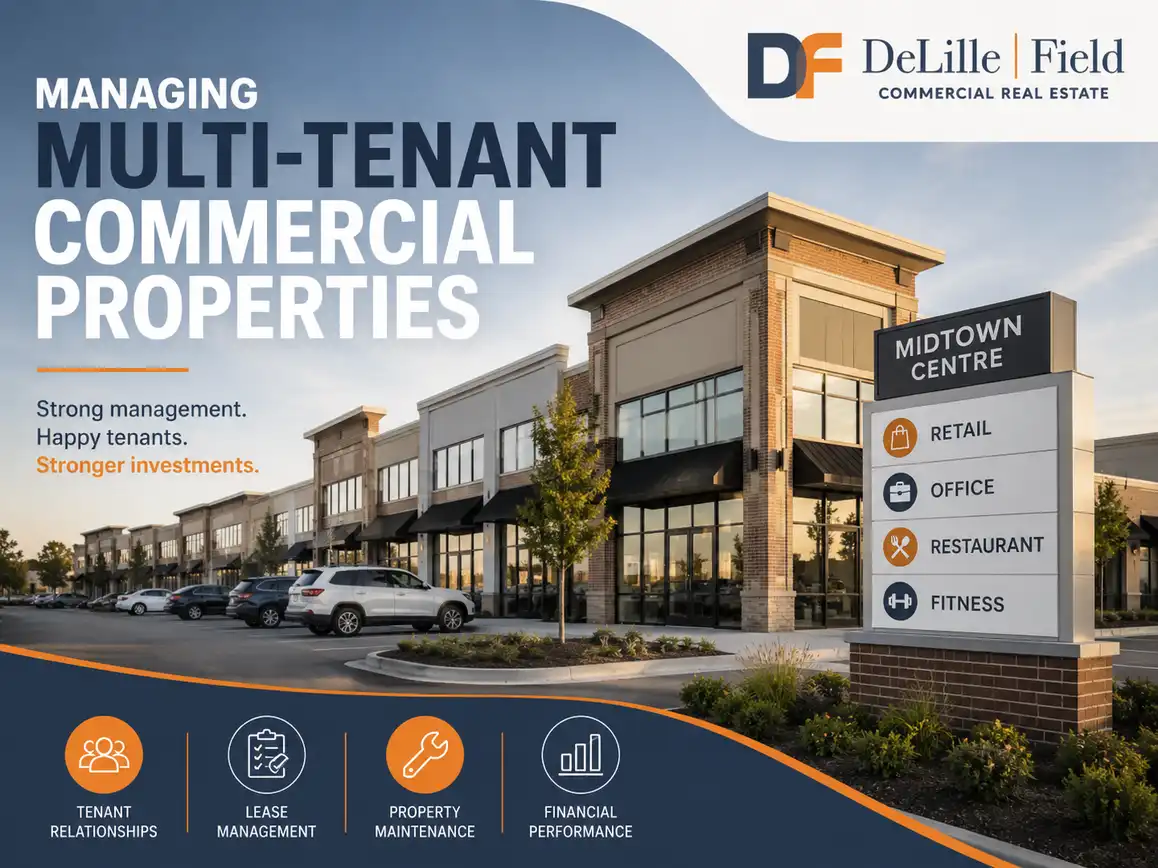
Managing a commercial property with multiple tenants can feel like running ten conversations at once. One tenant wants faster maintenance. Another has concerns about parking. A third is frustrated by noise from the tenant next door.
That’s the reality of multi-tenant property management. You’re not just maintaining a building — you’re managing expectations, relationships, schedules, and day-to-day operations across businesses that don’t necessarily share priorities.
The good news: most tenant frustrations are preventable. Clear communication, consistent systems, and proactive maintenance go a long way toward keeping operations smooth and tenants satisfied, and toward keeping them in the building when their lease comes up.
Why Multi-Tenant Property Management Is Harder Than It Looks
Every tenant uses the property differently. A retail store, an office, a restaurant, and a clinic may all share the same building, but their operational needs and pressure points are almost nothing alike.
That’s where the friction starts. Shared spaces like parking lots, elevators, loading areas, and common hallways become flashpoints when expectations aren’t clear. Small issues escalate quickly when they’re ignored: one tenant leaves inventory in a shared corridor temporarily, another sees it as a safety hazard. A maintenance response that feels minor to management can seriously disrupt a tenant’s ability to do business.
Reactive management almost never works long-term in multi-tenant buildings. Property owners and managers who stay ahead of issues see fewer complaints, higher renewal rates, and far less daily firefighting. Strong organization matters every bit as much as the physical condition of the building.
How to Communicate With Commercial Tenants Without Creating Frustration
Most tenant complaints aren’t really about maintenance or scheduling. They’re about feeling uninformed. Good communication builds trust, even during disruptions, and the fundamentals are simple:
- Send advance notice before repairs, inspections, or construction
- Share realistic timelines, not best-case ones
- Maintain a single, reliable point of contact for tenants
- Provide updates during ongoing issues, even when there’s nothing new to report
- Confirm in writing because verbal updates are often forgotten
Example: if parking lot repairs are planned for next week, giving tenants notice now lets them prepare staff and customers. Last-minute communication creates frustration even when the work itself is routine.
Scheduling matters just as much in buildings with shared resources. Loading docks, service elevators, contractor access, and parking areas all run more smoothly through organized schedules than informal coordination. Tenants appreciate structure because it helps them operate more efficiently.
How to Enforce Leases Fairly Across Different Tenants
One of the fastest ways to create tension in a multi-tenant building is inconsistent rule enforcement. Fair and consistent lease management means applying the same standards to every tenant regardless of square footage, lease size, or how long the relationship goes back.
That consistency applies to:
- Parking and signage rules
- Noise complaints and quiet hours
- Rent deadlines and late fee enforcement
- Common area usage
- Insurance and certificate requirements
If one tenant is regularly allowed to pay late without penalty, other tenants will eventually expect the same flexibility. Over time, inconsistent enforcement erodes the credibility of management and makes every conversation harder. Fair doesn’t mean strict. It means setting clear expectations and applying them evenly. Most tenants are reasonable when policies are communicated and enforced consistently.
The Case for a Staggered Maintenance Schedule
Maintenance issues are unavoidable in commercial properties. What separates well-run buildings from struggling ones is how those issues are managed.
Waiting until systems fail leads to bigger repair costs, more operational disruption, and frustrated tenants. A staggered maintenance strategy includes scheduling tasks across the year rather than reacting to failures and keeps the building running smoothly and the budget more predictable.
Categories that benefit most from planned scheduling:
- HVAC servicing (twice annually, spring and fall)
- Plumbing inspections and water system maintenance
- Lighting upgrades and electrical inspections
- Roof and exterior inspections
- Fire and life-safety system testing
- Parking lot and landscape maintenance
How maintenance requests are handled day-to-day matters just as much as the planned schedule. Tenants understand that repairs take time. What frustrates them most is silence. A quick acknowledgement that the issue has been received and is being scheduled goes a long way toward maintaining trust, even when the repair itself takes days.
Proactive maintenance is one of the strongest predictors of tenant retention. Businesses are far more likely to renew leases in buildings that feel responsive and professionally managed.
How Property Management Software Can Streamline Operations
Technology has made multi-tenant property operations significantly easier to organize. Most owners and managers today rely on property management software to centralize communication, maintenance tracking, billing, and documentation in one place.
Without good systems, requests get lost, follow-ups are missed, and communication drifts. The right platform helps simplify:
- Tenant maintenance requests and ticket tracking
- Rent collection and reminders
- Vendor scheduling and coordination
- Lease and document storage
- Tenant communication and updates
- Reporting on recurring issues and response times
Tenants can submit maintenance tickets online and track status updates without repeatedly calling management. Managers gain visibility into recurring issues and vendor performance, which makes patterns easier to spot and address before they grow. Strong systems reduce stress on both sides of the relationship.
The Bottom Line on Multi-Tenant Property Management
Managing multiple commercial tenants will never be completely effortless. Different businesses will always have different priorities, schedules, and expectations.
But strong communication, fair lease enforcement, planned maintenance, and reliable systems make the work far more manageable and the building far more successful. The goal isn’t to eliminate every problem. It’s to create a property where tenants feel informed, supported, and confident in management. That’s what drives renewals.
Overwhelmed by Day-to-Day Tenant Management?
If tenant relationships and daily operations are starting to take more time than they should, the DeLille | Field property management team can help. We work with owners and operators to streamline processes, improve tenant communication, and create a smoother experience on both sides of the lease.
Get in touch today to talk through your property and where the friction is showing up.
Frequently Asked Questions
Q1: How do you manage multiple commercial tenants fairly?
Ans: Apply lease policies consistently across every tenant, communicate expectations clearly upfront, and document decisions so there’s a record when disputes arise. Fairness comes from consistency, not flexibility. Most tenants are reasonable when they know the rules apply equally to everyone in the building.
Q2: How do I handle a conflict between two tenants in the same building?
Ans: Address the issue early, before it escalates. Stay neutral, refer back to lease terms and building rules rather than personal judgment, and document the conversation and resolution. Letting tenant conflicts simmer almost always makes them worse and harder to resolve.
Q3: How do I reduce tenant turnover in a multi-tenant commercial building?
Ans: Strong communication, proactive maintenance, fair lease enforcement, and a property that simply runs well are the biggest factors in renewals. Tenant turnover is expensive — between vacancy loss, tenant improvement costs, marketing, and broker fees, replacing a tenant typically costs far more than retaining one.
Q4: What should a commercial tenant onboarding process include?
Ans: A strong onboarding covers access details and security procedures, emergency contacts and procedures, parking and signage rules, common area policies, maintenance request workflows, billing and rent payment procedures, and insurance requirements. Tenants who are onboarded well rarely create avoidable friction later.
Q5: When should I consider hiring a property manager instead of self-managing?
Ans: If tenant issues, maintenance coordination, and lease administration are consistently taking more time than they should — or if missed details are starting to affect tenant satisfaction — it’s probably time. Many owners switch to professional management when their portfolio grows beyond what they can monitor closely without a dedicated team.
Q6: What does tenant turnover actually cost in a commercial building?
Ans: It depends on the property and market, but total turnover costs typically include vacancy loss, tenant improvement allowances, marketing and brokerage commissions, and any required repairs or upgrades. For most commercial spaces, it’s significantly more cost-effective to invest in retention than to fill a vacancy.
This article is for educational purposes only and does not constitute legal, financial, or investment advice. Specific lease terms, tenant agreements, market conditions, and individual circumstances vary. Consult a qualified attorney, broker, or advisor before making decisions related to your commercial property or lease.
Related Reading
- What Does A Commercial Property Management Company Do
- Property Management
- Common Area Maintenance In Commercial Leases